JT Rosette-tool

Instructions how to use

This tool is designed to cut rosette channels and soundholes using a router. For guitars and ukuleles.

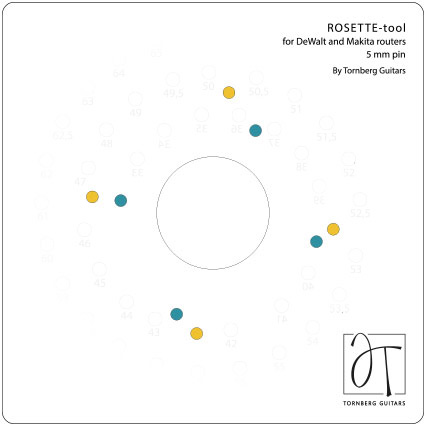
It has been tested with the following handheld router models, with corresponding mounting screw holes color-coded for easy identification.

Before mounting the Rosette-tool, remove the router’s original base plate.

Makita RTO700 / RTO702 / DRT50

Dewalt 900W

Selecting the right pivot hole (radius)

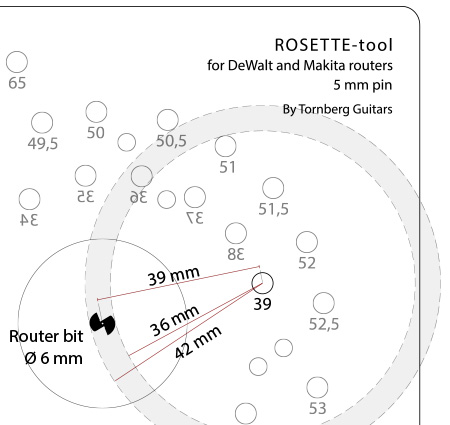
The router works as a compass rotating around the selected pivot hole, cutting a precise circle. The pivot hole determines the radius of the cutting path. Router bit size determines the inner and outer dimensions of the circle. The pivot hole numbers are millimetric measurements of the radius on that exact pivot hole. This marked radius is measured from the center of the pivot hole to the center of the router bit. The circle might have a ±0.3 mm tolerance due to the router’s base.

Example: Pivot hole radius 39  + half of 6 mm bit (3 mm) = 42 mm total radius.

Pro tip!
Use router bits of different sizes to achieve a wider range of radii. For example, 5 mm pit adds 2.5 mm to the radius.

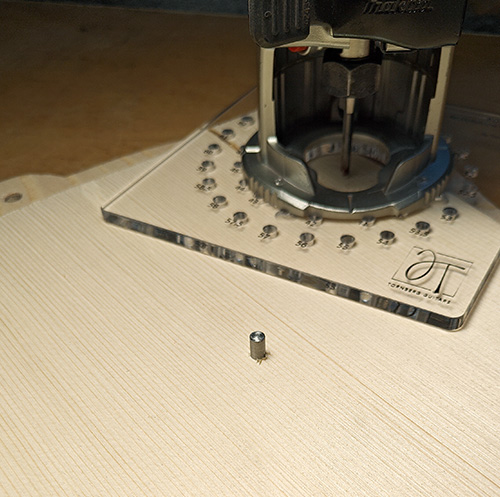
1. Use a plywood board approximately 20 mm thick beneath the top. The plywood should be at least as large as the guitar top to provide even support across the entire surface. Drill a hole perpendicular to the plywood for the pivot pin, matching the size of the pin. The hole should go all the way through the plywood. Fit the top onto the pin and secure it in place.
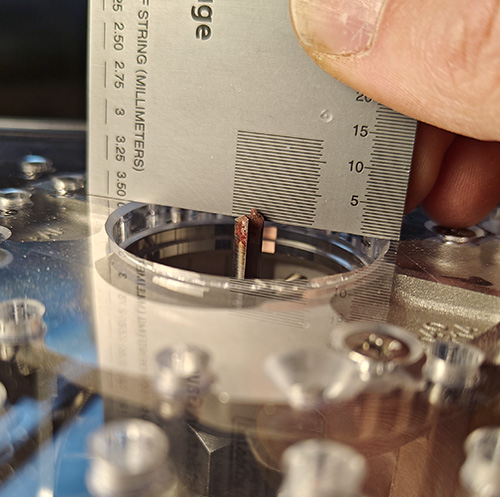
2. Set your cutting depth before fitting the router onto the pivot pin. The router base may have a slight amount of play, so adjusting the depth while cutting could slightly alter the diameter of the cut.
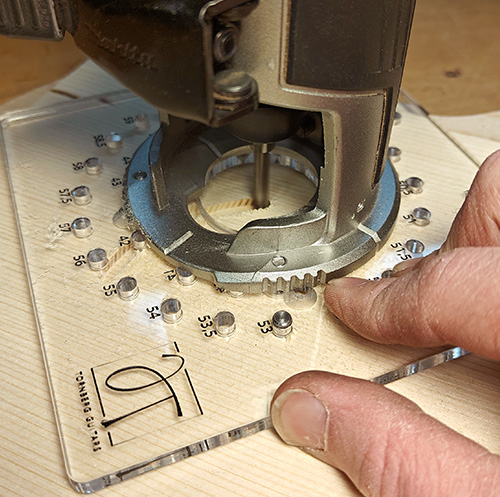
3. Select the correct pivot hole and press the plate onto the pin. Keep the router bit slightly raised before turning on the router. Once it’s running, lower the bit into the wood until the base plate sits flat.

4. Begin the cut in the area that will be beneath the fingerboard. You can check the depth and radius before you start moving the router. Then, move the router around the pivot pin to create a perfect circle. The circle might have a ±0.3 mm tolerance due to the router's base.

I would appreciate your feedback on the tool.

Please feel free to share a comment at juuso@tornbergguitars.com​